The Effect of Alcohol Sales Taxes on Off-Site Alcohol Purchases
Abstract
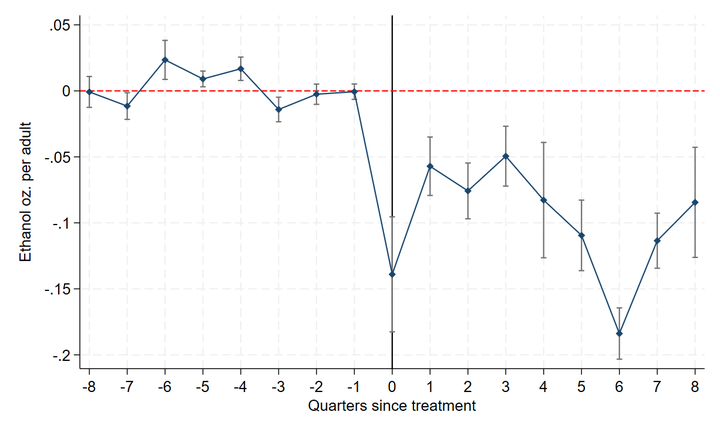
While most research on alcohol taxation focuses on volume-based excise taxes, much less is known about the effects of sales taxes, which are applied as a percentage of retail prices and may differ in salience and incidence. This paper evaluates the impact of Maryland’s 2011 three percent alcohol sales tax on household alcohol purchases using NielsenIQ Consumer Panel data and a synthetic difference-in-differences design. I find that the tax reduced monthly ethanol purchases per adult by approximately nine percent among households that purchase alcohol, corresponding to about 1.7 fewer standard drinks per adult per month. Declines are observed across beer, wine, and spirits, with no evidence of substitution toward any single beverage category. Reductions are present across the purchasing distribution, with the largest absolute declines among high-purchasing households, and broadly similar patterns are observed across demographic groups. Additional analyses provide little evidence that border-county households offset the tax through cross-border shopping. These findings provide new evidence on the behavioral effects of sales taxes and suggest that price-based alcohol policies can meaningfully reduce alcohol purchases.

Ana Paula Milan Hinostroza
PhD candidate in Economics
I am a doctoral candidate in Economics at the University of New Mexico. My research lies at the intersection of health and public economics, with a focus on programs and interventions aimed at mitigating the negative externalities of risky health behaviors. My current work examines how public policies, particularly alcohol taxation, influence risky health behaviors and related societal outcomes, including crime.